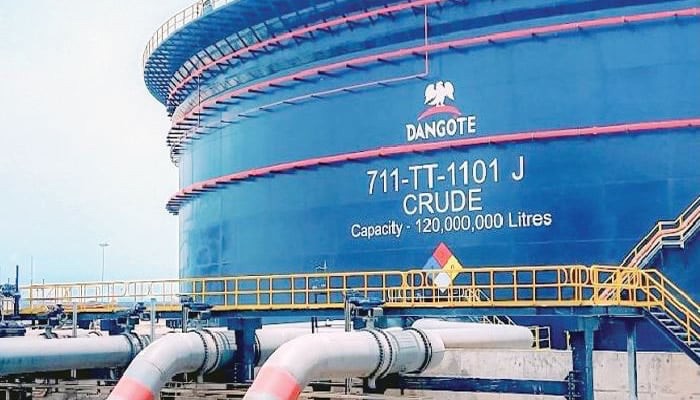
Nigeria’s oil industry is facing a striking contradiction importing crude oil while being one of the world’s major producers.
In 2025, the Dangote Petroleum Refinery imported crude oil worth $3.74 billion, according to data from the Central Bank of Nigeria. This development has raised fresh concerns about structural inefficiencies within the country’s petroleum sector.
While crude imports increased, Nigeria’s crude oil exports declined from $36.85 billion in 2024 to $31.54 billion in 2025, representing a 14.41% drop. This shift has impacted the country’s external trade balance.
However, the refinery’s operations have helped reduce reliance on imported fuel. Spending on refined petroleum imports fell significantly to $10 billion in 2025, down from $14.06 billion in 2024. At the same time, exports of refined petroleum products reached $5.85 billion, supporting foreign exchange inflows.
Nigeria still recorded a current account surplus of $14.04 billion in 2025, although lower than the $19.03 billion reported in 2024. The surplus was driven largely by improved trade performance linked to refining and gas exports.
Despite these gains, pressures remain. Non-oil imports rose to $29.24 billion, while spending on services such as transport, travel, and insurance increased. In addition, higher dividend and interest payments to foreign investors pushed primary income outflows upward.
A key issue remains Nigeria’s ongoing oil supply paradox. Despite policies aimed at prioritising domestic crude supply, local refineries continue to face feedstock shortages. This has forced operators like Dangote Refinery to rely on imported crude to sustain production.
The situation highlights the need for improved supply coordination, stronger policy implementation, and better infrastructure to fully optimise Nigeria’s oil resources.