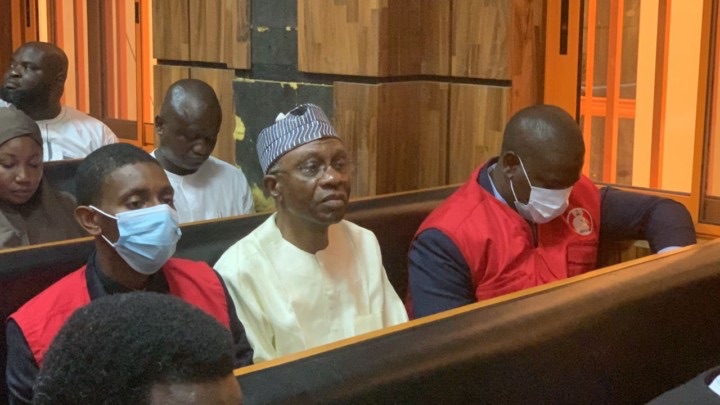
A witness testifying in the trial of former Central Bank of Nigeria (CBN) Governor, Godwin Emefiele, has informed a Federal Capital Territory (FCT) High Court in Abuja that over $6 million was withdrawn from the apex bank using falsified documents.
The witness, Bashirudden Maishanu, an assistant director at the CBN and the 11th prosecution witness presented by the Economic and Financial Crimes Commission (EFCC), gave his testimony on Thursday before Justice Hamza Muazu.
While being questioned by EFCC’s Director of Public Prosecutions, Rotimi Oyedepo, Maishanu stated that the sum of $6.23 million was collected in cash from the CBN’s Garki branch on February 8, 2023.
He told the court that in January 2023, he was contacted by a man identified as Alhaji Ahmed, who claimed to be part of a special committee operating under the Office of the Secretary to the Government of the Federation (SGF). Ahmed allegedly said he was sent by Eric Ocheme, described as Emefiele’s personal assistant at the time, to follow up on certain financial transactions.
According to Maishanu, Ahmed later claimed that presidential authorisation had already been secured for the transaction and that Emefiele’s approval was the final requirement. He further disclosed that Ahmed insisted the funds be released in cash and asked him to either accompany the collection or suggest someone else.
Maishanu said he declined to escort the cash and instead recommended an acquaintance. He confirmed that the withdrawal was eventually completed on February 8, 2023.
He testified that after the money was released, Ahmed reportedly took $2.5 million, while another $2.5 million was temporarily left in the custody of himself and two others. He described the situation as alarming, noting that no prior agreement existed for any payment, and said he advised that the money be held, which was accepted.
The witness told the court that the funds were allegedly intended for election-related expenses, including payments to election observers during the 2023 general elections.
Explaining internal procedures, Maishanu said the CBN has strict disciplinary measures for staff misconduct, ranging from official warnings to dismissal, depending on the severity of the offence. He added that such decisions are handled by a disciplinary committee in line with the bank’s human resource policies, stressing that he was not sanctioned by the CBN board over the incident.
During cross-examination by defence lawyer Matthew Burkaa, Maishanu admitted he did not personally witness the signing of the approval documents but maintained that the paperwork was forged. He said this conclusion was based on the bank’s strict protocols, particularly for large cash transactions.
He also explained that every stage of the withdrawal process leaves a clear paper trail, making it possible to identify all officials involved. The witness further acknowledged that he did not take part in election monitoring and initially did not realise the transaction involved fraudulent documents.
Maishanu said he later came across forged approvals linked to the withdrawal and accepted responsibility for his role, describing the incident as a deliberate “set-up.”
Justice Muazu subsequently adjourned the case to January 30, 2026, for the continuation of the trial.