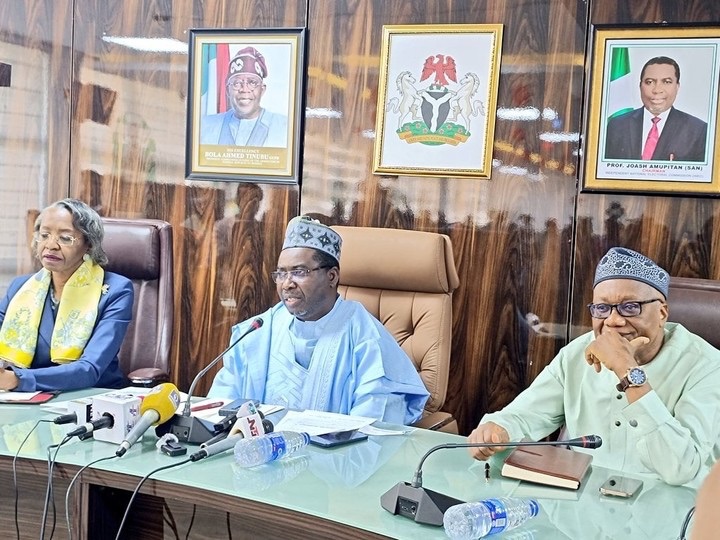
INEC Receives Over N1 Trillion Allocation in 2026 Budget Ahead of 2027 Elections
The Independent National Electoral Commission INEC has been allocated N1,013,778,401,602 in the 2026 budget presented to the National Assembly by President Bola Ahmed Tinubu.
The allocation, one of the largest in the commission’s history, comes as Nigeria prepares for the 2027 general elections. Details are contained in the 2026 Appropriation Bill released by the Budget Office of the Federation.
President Tinubu presented a total budget of N58.18 trillion to the National Assembly. The proposed budget, tagged “Budget of Consolidation, Renewed Resilience and Shared Prosperity,” projects total revenue of N34.33 trillion and total expenditure of N58.18 trillion, including N15.52 trillion for debt service.
While INEC has consistently stressed the need for adequate funding to ensure credible elections, observers note that the allocation will be tested by major logistical demands such as procurement of technology, voter education, and nationwide staff deployment.
Section 3(3) of the Electoral Act 2022 mandates that election funds be released at least one year before a general election. The section states that funds due to the commission for any general election must be released not later than one year before the polls.
In 2025, the National Assembly approved an upward review of INEC’s budget to N140 billion from the N40 billion initially proposed by the Federal Government. For the 2023 general elections, the commission spent N313.4 billion. However, INEC disclosed in its 2023 General Election Report that out of the N355 billion approved, only N313.4 billion had been released as of September 2023.
For earlier elections, the National Assembly approved N143 billion for the 2019 polls, while Nigeria spent about N108.8 billion to conduct the 2015 general elections.
The Guardian reports that Professor Bolade Eyinla, immediate past Chief Technical Adviser to the INEC Chairman Professor Mahmood Yakubu, projected in October that the commission may spend about N870 billion, equivalent to about 600 million dollars, to conduct the 2027 general election.
Speaking at a Yiaga Africa 2027 Elections Scenarios and Election Manipulation Risk Index Retreat in Abuja, Eyinla described Nigeria’s elections as among the largest civil operations in peacetime, requiring extensive financial, technological, and logistical resources.
According to him, the projected cost reflects the scale of operations in a country with over 93 million registered voters, 176,846 polling units, and 1,558 electoral constituencies. He explained that the estimate is informed by previous election costs, noting that the 2015 elections cost N109 billion, the 2019 elections N189 billion, and the 2023 elections N355 billion.
Eyinla said that after accounting for inflation, currency fluctuations, and operational expansion, the N870 billion projection for 2027 is realistic. He added that the estimated cost translates to about 6.72 dollars per voter, which falls within international norms for transitional democracies.
He further noted that Nigeria’s election costs are among the lowest in Africa when compared with countries such as Kenya, Ghana, South Africa, the Democratic Republic of Congo, and Liberia, as well as India, the world’s largest democracy.
According to him, considering current economic conditions, inflation, and data from the National Bureau of Statistics, conducting the 2027 general election will require about 600 million dollars, approximately N870 billion, assuming prudent management of resources by INEC.